Almost any soup can be microwaved, but the method matters. Thick soups and stews bubble from the bottom and splash. Broth-based soups can superheat silently and then erupt when you stir them. Both risks are easy to avoid with the right container and technique.
YES — microwave soup in a deep microwave-safe bowl, loosely covered, at 70% to 100% power for 2 to 4 minutes. Stir once halfway through. Never seal the lid — steam must be able to escape.
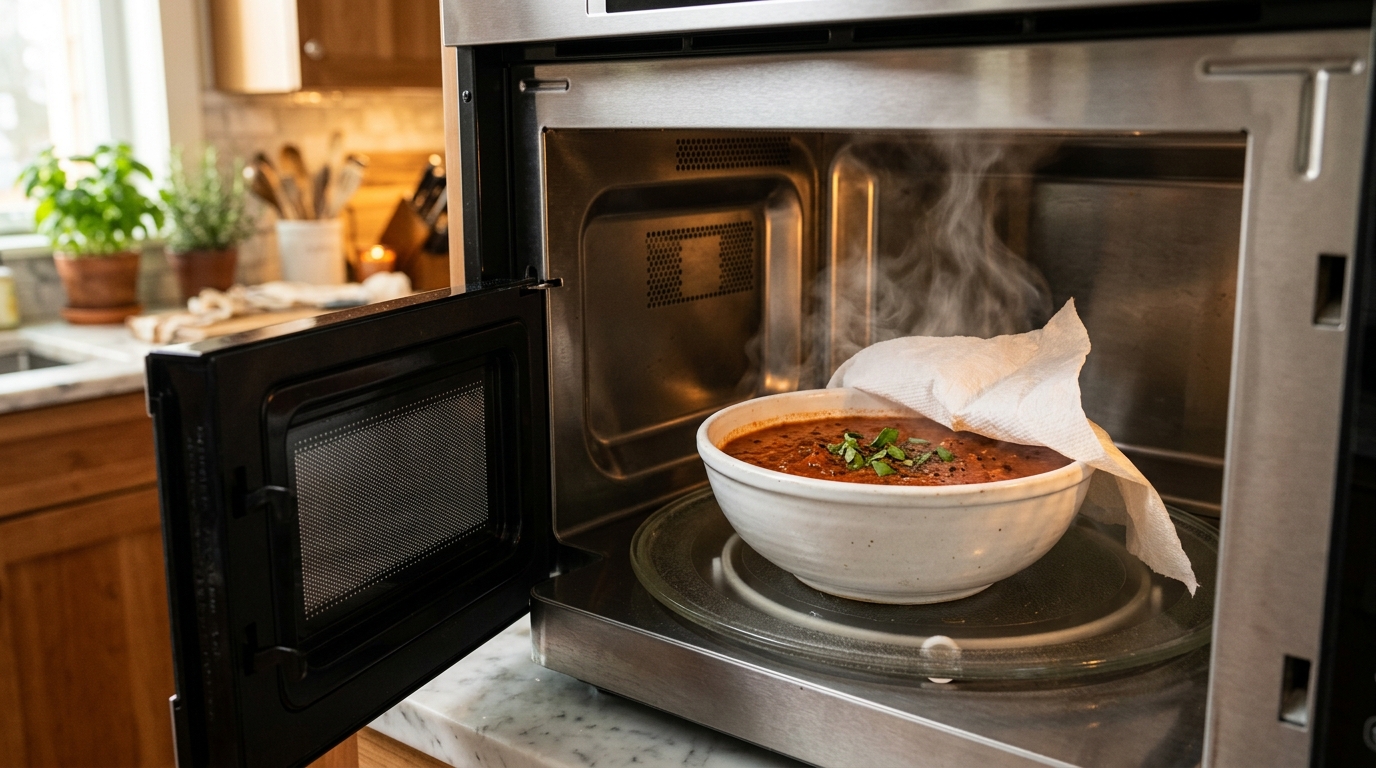
Can You Microwave Soup?
Yes. Soup is one of the most common things people microwave. The key variables are the bowl depth, the cover, and whether you stir partway through. A standard 12 oz serving of refrigerated soup heats through in 2 to 3 minutes at 100% in a deep microwave-safe bowl. Thick soups (chili, cream of mushroom, chowder) take closer to 3 to 4 minutes and benefit from 70% power to prevent violent bubbling at the bottom.
Best Method: Step-by-Step
The depth of the bowl matters more than most people realise. A shallow bowl spreads the soup thin — the edges overheat while the centre stays cold. A deep bowl keeps the depth consistent so heat distributes more evenly.
- Pour the soup into a deep microwave-safe bowl (not a shallow plate or wide dish).
- Leave at least 1 inch of headspace at the top — soup expands as it heats.
- Place a microwave-safe lid or damp paper towel loosely on top — do not seal it.
- Microwave at 100% for 90 seconds (thin broth soups) or 70% for 2 minutes (thick creamy soups).
- Stop and stir from the bottom up. This breaks the temperature gradient and prevents superheating.
- Continue at the same power level for another 60 to 90 seconds.
- Check temperature — soup should be steaming visibly, at least 165°F (74°C) if it contains meat.
The stir halfway through is not optional for thick soups. Cream soups and stews form a skin on top and an overheated layer on the bottom — stirring equalises both.
The Superheating Risk with Clear Soups
This is specific to thin, water-based broths heated in a clean smooth container with no stirring. When liquid heats beyond its boiling point without any nucleation sites (tiny roughness, particles, bubbles) to trigger boiling, it stays liquid — until you disturb it. Then it flashes to steam instantly, sometimes explosively. The fix is simple: stir at the halfway point. That one action is enough to prevent superheating in almost all practical cases.
Cream Soups and Splatter Control
Cream of tomato, butternut squash soup, and similar thick purees tend to pop and splatter at full power because the dense liquid superheats locally at the bottom before convection can distribute the heat. Use 70% power and a loose cover. If the soup still splatters, drop to 50% and extend the time to 4 to 5 minutes, stirring every 90 seconds.
Common Pitfalls and Safety Warnings
- Sealed containers: never microwave soup in a sealed container — pressure builds as steam cannot escape. Lids can blow off or containers can burst.
- Metal in cans or containers: do not microwave soup directly in the can. Always transfer to a microwave-safe bowl first.
- Superheating: clear broth soups in smooth bowls are the highest risk — always stir before and after microwaving.
- Uneven heating: always check the centre temperature. Soup hot on the edges can still be cold in the middle of a thick stew.
- Meat safety: soup containing poultry, pork, or seafood must reach 165°F (74°C) throughout.
Microwave Heating Comparison
| Soup Type | Power | Time (12 oz) | Key Step |
|---|---|---|---|
| Broth / clear soup | 100%, loose cover | 2 to 3 min | Stir halfway — prevents superheating |
| Cream soup / chowder | 70%, loose cover | 3 to 4 min | Stir at 90 sec to prevent skin |
| Chili / thick stew | 70%, loose cover | 4 to 5 min | Stir every 90 sec, check centre |
| Frozen soup (block) | 50% defrost, then 100% | 5 min + 3 min | Break up block at 5 min, then finish |
Related Articles
- Can You Boil Water in the Microwave?
- Can You Reheat Leftovers Twice?
- Can You Microwave Raw Chicken?
- Can You Microwave Ceramic?
- Can You Microwave Glass?