Microwaving pizza still in the box is tempting, but it is a real fire risk. Cardboard can ignite when it is grease-soaked or heated for more than 2 minutes. A clean, dry corner of box for under 60 seconds is unlikely to cause a problem — a box soaked in pizza grease for 5 minutes at full power can smoulder or catch fire. The box is not the issue. The grease in the box is.
NOT RECOMMENDED — pizza boxes are made from cardboard that can ignite when grease-soaked, especially above 2 minutes. Metal staples in some boxes can arc. Transfer pizza to a microwave-safe plate instead.
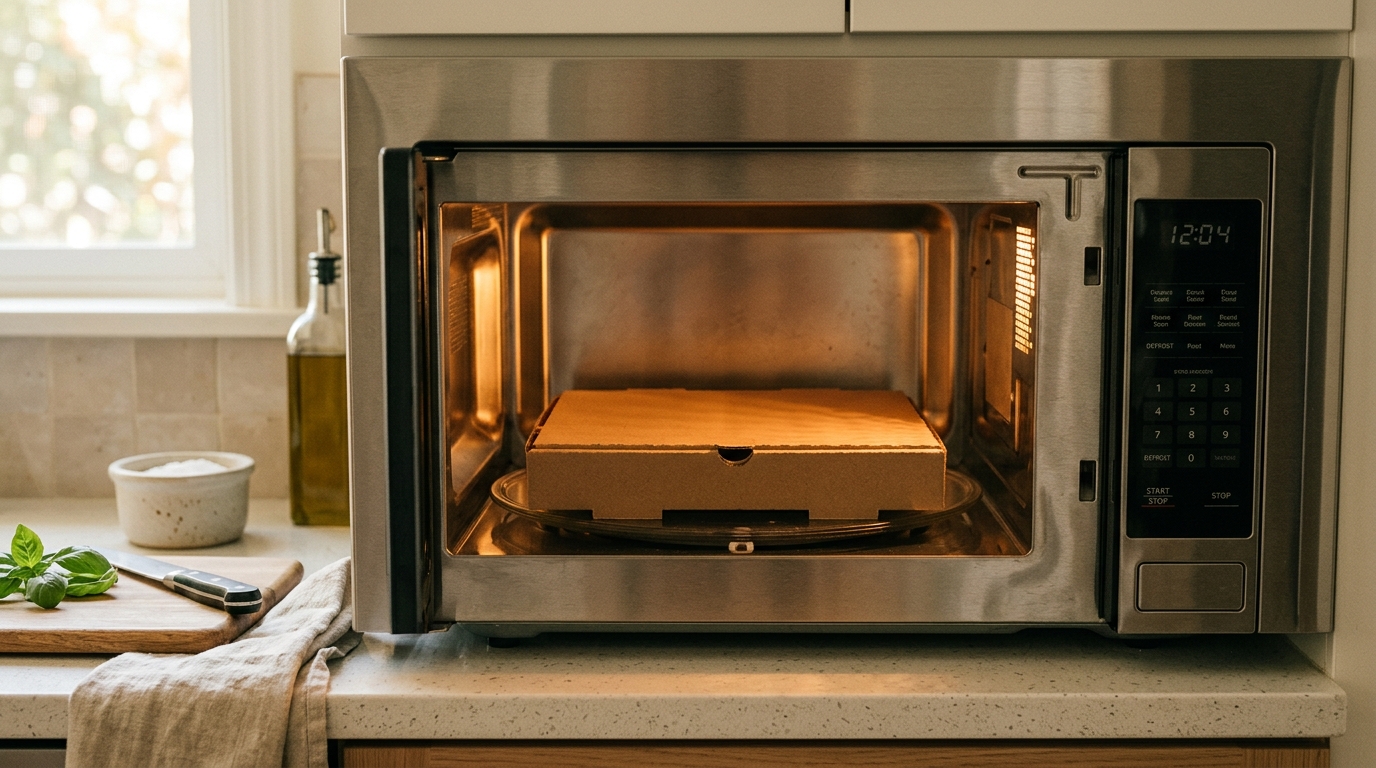
Is a Pizza Box Microwave-Safe?
No, and yes — it depends entirely on the condition of the box and the heating time. Plain, dry, unprinted cardboard passes microwave energy through it without absorbing much. But pizza boxes are almost never plain and dry. They contain: grease absorbed from the cheese and oil, printed ink (some inks contain metallic compounds), a possible wax or moisture-barrier coating, and sometimes metal staples or clips holding the box together. Any of those four factors can create a problem in the microwave.
The most common failure mode: grease-saturated cardboard heats rapidly because fat absorbs microwave energy efficiently. The cardboard fibers around the grease can reach ignition temperature (around 451°F / 233°C) within 2 to 3 minutes at full power in a hot, grease-heavy spot.
The Core Risks: Grease Fire and Arcing
Cardboard itself has a relatively high ignition point — around 451°F (233°C). A clean, dry cardboard box is unlikely to reach that temperature in under 2 minutes at 100% power. The danger comes from grease. Pizza grease soaks into the corrugated cardboard fibres. Fat heats much faster than cardboard — it can reach 400°F or above before the box itself would normally ignite, heating the cardboard fibres from the inside where it is already pre-saturated.
Metal staples, which some pizza box manufacturers use, are a separate risk. Metal in a microwave causes arcing — visible electric spark discharge between the metal point and the microwave cavity wall or the turntable. A single metal staple in the wrong position can damage the microwave magnetron permanently.
Printed inks are a third concern. Some cardboard box inks contain metallic pigments — particularly dark colours. These can cause minor arcing on the printed surface.
How to Tell If Your Box Is Safe for 60 Seconds
If you are going to use the box at all, check for these first:
- No visible grease stains on the bottom of the box interior — if the cardboard is visibly translucent with grease, do not use it.
- No metal staples — check the corners and the box lock tab. Some boxes use metal fasteners.
- No plastic inserts, dividers, or small cardboard feet — these can melt or heat unevenly.
- Time limit: 60 seconds maximum at 70% power. Not 2 minutes. Not full power. One minute.
Even meeting all four criteria, the safer option is to transfer the pizza to a microwave-safe plate. The result is better anyway — ceramic and glass plates allow more even heating of the crust than cardboard does.
The Right Way to Reheat Pizza
For best results — a crispy-ish crust, melted cheese, not soggy — place pizza slices on a microwave-safe plate. Put a small microwave-safe cup of water next to the plate (not touching the pizza). Microwave at 70% power for 60 to 90 seconds. The water absorbs some of the microwave energy and produces steam that keeps the crust from becoming cracker-dry. The plate heats the bottom of the crust more directly than cardboard would.
Safe Alternatives to Use Instead
Use a microwave-safe ceramic plate (any plain ceramic plate without metallic glaze or trim) or a glass plate. Both pass microwave energy to the food rather than absorbing it. If you want a crispier result, a microwave crisper tray — a special susceptor-lined tray designed to absorb microwave energy and convert it to conductive heat — will give you a better crust than any flat plate or cardboard box.
Material Safety Comparison
| Container / Surface | Microwave-Safe? | Max Safe Use | Key Risk |
|---|---|---|---|
| Ceramic plate (no metallic glaze) | YES | Unlimited | None |
| Glass plate | YES | Unlimited | None (borosilicate only) |
| Pizza box (clean, dry, no staples) | CONDITIONAL | 60 sec at 70% | Grease ignition above 2 min |
| Pizza box (grease-soaked) | NO | Never | Fire risk from grease-heated fibres |
| Pizza box with metal staples | NO | Never | Metal arcing — magnetron damage |
Related Articles
- Can You Microwave Cardboard?
- Can You Microwave Paper Plates?
- Can You Microwave Frozen Pizza?
- Can You Microwave Tin Foil?
- Can You Microwave Ceramic?