Microwaved salmon turns out moist and fully cooked in under 5 minutes — if you use medium-low power and keep it covered. Use 100% power and you get rubbery, dry fish with a steaming-fish smell strong enough to clear a room. Power level is the single variable that separates a great result from a bad one.
YES — microwave salmon at 50% power for 3 to 4 minutes per 6 oz fillet in a covered microwave-safe dish. Rest 1 minute before serving. Internal temperature must reach 145°F (63°C).
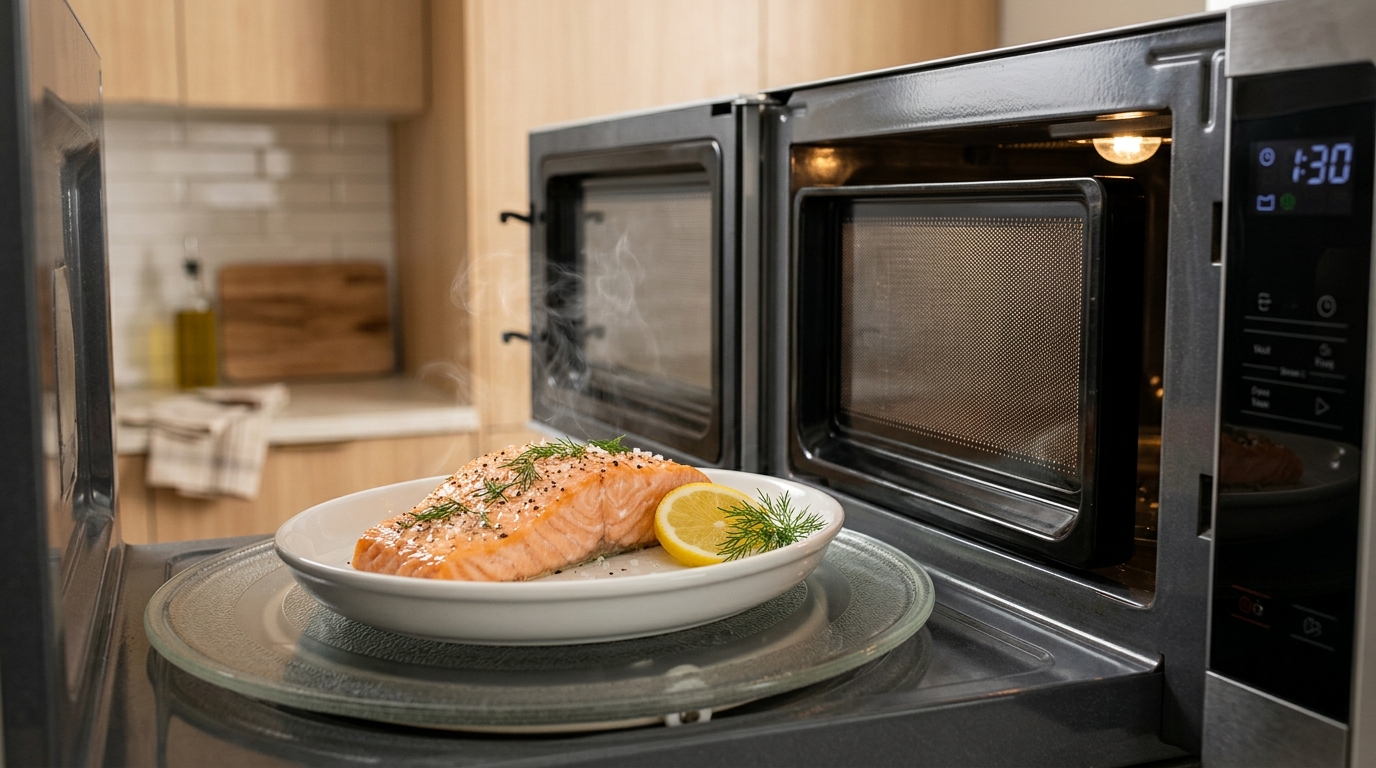
Can You Microwave Salmon?
Yes. Salmon microwaves well at 50% power in a covered dish. The lower power setting lets the heat penetrate gradually without seizing the proteins at the surface before the centre is cooked. A 6 oz (170 g) fillet takes 3 to 4 minutes. Thicker portions (over 1 inch) need an extra 30 to 60 seconds. The target internal temperature is 145°F (63°C) — check the thickest part with an instant-read thermometer.
Best Microwave Method: Step-by-Step
Salmon releases moisture as it cooks, so covering the dish is non-negotiable. The steam keeps the surface from drying out while the interior reaches temperature.
- Place the fillet skin-side down in a microwave-safe dish with a lip (not a flat plate).
- Add 2 tablespoons of water, white wine, or lemon juice to the dish.
- Cover tightly with a microwave-safe lid or a plate turned upside down.
- Microwave at 50% power for 3 minutes for a 6 oz fillet.
- Check the thickest part with a fork — it should flake easily and look opaque.
- If not done, add 30-second intervals at 50% until the fork test passes.
- Let it rest covered for 1 minute before serving.
The standing time matters. Salmon continues cooking from residual heat for 30 to 60 seconds after the microwave stops — pulling it out just before it looks done gives you a moister result.
How to Avoid Ruining the Texture
The main failure mode with microwaved salmon is protein squeeze — the white albumin (that chalky white stuff) pushes out of the flesh when the heat is too high or the cooking is too fast. Once that happens, the fish is dry and tough in the centre. You cannot fix overcooked salmon.
Three things prevent it: 50% power (not full), a covered dish (steam), and resting before you cut. A thin fillet of Atlantic salmon (under 3/4 inch) may only need 2 to 2.5 minutes at 50% — check at 2 minutes to avoid overcooking.
Wild-caught salmon varieties (sockeye, coho, pink) have less fat than farmed Atlantic salmon and dry out faster. If you are microwaving wild salmon, add the liquid to the dish and check at 2 minutes.
Smell, Reheating, and Fridge Life
Fresh salmon should be cooked and eaten the same day, or stored in the fridge for up to 2 days. Cooked salmon keeps for 2 days covered in the fridge. To reheat already-cooked salmon, use 50% power for 1 to 2 minutes — it reheats faster than raw salmon cooks.
The smell is real. Microwaved fish releases trimethylamine gas as the proteins break down at heat. Covering the dish during cooking contains most of it. Open a window after. Do not leave cooked salmon in the microwave with the door closed — the smell absorbs into the plastic interior.
Common Pitfalls and Safety Warnings
- Full power: cooking salmon at 100% power causes the proteins to contract violently — the result is rubbery and dry, often with a burst of steam that cracks the cover.
- No liquid: without water or wine in the dish, the surface of the fillet dries and toughens before the centre is done.
- Uncovered: salmon without a cover loses moisture on the surface. The edges cook at double the speed of the centre.
- Skin side up: the skin reflects microwave energy and blocks penetration. Always cook skin-side down.
- Eating cold salmon straight from fridge: cold dense fish takes 30 to 60 seconds longer per 6 oz than room-temperature fish.
Microwave Heating Comparison
| Power Level | Time (6 oz fillet) | Cover | Result |
|---|---|---|---|
| 50% (Medium-Low) | 3 to 4 min + 1 min rest | Tight lid or plate | Moist, flaky, fully cooked |
| 70% (Medium-High) | 2 to 3 min | Loose lid | Acceptable, slightly drier edges |
| 100% (High) | 1.5 to 2 min | Any | Rubbery, dry, albumin squeeze |
| 50% Reheat (cooked) | 1 to 2 min | Tight lid | Warm through, moist if not overcooked |
Related Articles
- Can You Microwave Shrimp?
- Can You Microwave Crab Legs?
- Can You Microwave Mussels?
- Can You Defrost Fish in the Microwave?
- Can You Microwave Raw Chicken?
One Response to “Can You Microwave Salmon?”
Read below or add a comment...
Trackbacks
[…] Can You Microwave Salmon? […]